First Day:At the morning, you will arrive in Tangier.
You will land at Tangier’s airport and take a short journey to the Medina, the heart of the city and its harbor. Staying in a refurbished Medina townhouse with a harbor view tonight and tomorrow night.
Until the middle of the twentieth century, when it was liberated from the French, Tangier was a free international zone, setting it apart from any other city in Morocco.
With two nights in Tangier, you’ll have plenty of time to see the city and the surrounding area; we recommend venturing down the coast to the little fishing village of Asilah.
Day 2:Two Cities in One Day: Tangier and Asilah
Check out Tangier first thing in the morning, then go south to the enchanting medina of Asilah in the afternoon (approx. 90 minutes round-trip).
Day 3:Chefchaouen
Take a morning ride south-east to the Rif Mountain foothill town of Chefchaouen, known as the “Blue City.” Get there in time for lunch, and then take a stroll around the fascinating medina.
Stay at a charming inn for the night.
Going to Fes on Day 4 from Volubilis and the Moulay Idriss
Get an early start, since you’ll have a long day of travel ahead of you before you reach Fes this evening.
Descend south from the Rif Mountains, with your first stop being at the Volubilis Roman Ruins. Experience the ruins on your own or with a local guide.
The biggest and best-preserved Roman remains in Morocco may be found at the city of Volubilis, which is on the list of UNESCO World Heritage Sites. Both the triumphal arches and basilicas on the upper levels and the mosaic flooring on the lower levels have been retained as they were originally laid.
Take a short trip from Volubilis to the holy village of Moulay Idriss (now being considered for candidacy to UNESCO) for lunch. The town’s shrine honors the earliest Muslim dynasty in Morocco, whose namesake the town is named after.
In the middle of the day, continue your trip to Meknes, another UNESCO World Heritage Site.
The majestic structures in Meknes harken back to the time when the city was initially erected by the great sultan Moulay Ismail to compete with the court of Louis XIV of France in the 17th century.
Get to the Fes medina by the time it becomes dark out. Come on in to your riad, where you’ll spend tonight and tomorrow night.
Day 5 :Fes
Have breakfast, and then have a guided stroll around the medina to learn your way around the ancient streets. Medina is the biggest urban car-free zone in the world and a UNESCO World Heritage Site.
Some of the most impressive examples of medieval Moroccan art and architecture may be seen in the medersas of the Imperial City, which date back to the 14th century (mosaics, cedar wood, stucco, marble, calligraphy all adorn such buildings). While non-Muslims are not permitted into other holy structures, you may get a good look at them from a rooftop patio. Since Fes was the original home of Morocco’s Muslim kingdom, it holds a special place in the country’s religious history.
If you have time in the afternoon, you may have your driver take you beyond the city walls to one of the hills to get a bird’s-eye view of the Fes medina, which is built inside what seems like a natural amphitheatre.
Spend the night in a medina riad.
In the heart of Fes, the Medina, you’ll find the wild Morocco
Todra Gorge, Day 6
The trip across the Atlas Mountains to the Todra Gorge begins bright and early.
After breakfast, go out of Fes towards the High Atlas Mountains, passing through the cedar woods outside of the city (which are home to the endangered Barbary Macaque species) on the way to Ifrane and Midelt. Following a path that becomes progressively more desolate, you’ll eventually reach the Todra River and its Gorge, and then the green palm oasis of Tinghir.
Spend the night in the palm oasis in a guest home.
Day 7: Today we will go to the Draa Valley by way of Jebel Saghro.
Go from mountaintops to desert oasis today. Travel through the Jebel Saghro’s Anti-Atlas area via the unspoiled Tizi n Tazazert mountain pass, which offers sweeping vistas, to the unparalleled Draa Valley, where you’ll spend the next two nights sleeping under the swaying palm fronds.
Volcanic and completely alien, the Jebel Saghro stands in the middle of the desert. Canyons, isolated towns, and craggy mountains make up the landscape. The Sahara Desert may be found to the south.
Nkob, a settlement at the base of the Saghro, is dotted with kasbahs and provides for a pleasant stopover. You can get to the Draa just beyond that point.
The Draa is the longest river in Morocco and it used to run uninterrupted all the way to the Atlantic. It’s surrounded by impressive palm oasis, historic kasbahs, and enticing mountain reliefs. Plan on staying two nights in Agdz, one night in one of the oasis hotels and one night at a hotel on the riverbank. Unless the dam upstream is opened or there have been unusually large rainfall, the Draa remains dry.
The Agdz Draa Valley: Morocco’s Last Wilderness
Draa Valley, Day 8
Have a relaxed morning strolling around one of the palm oasis with a guide, seeing the horticulture and basic houses. After that, you’ll eat lunch in a traditional Moroccan house, courtesy of your driver.
Have a relaxing day taking in the scenery from the hotel. You might also go on foot to investigate the kasbahs in the area.
Dunes of Erg Chigaga, Day 9
Take a trip to the Sahara by way of the Draa Valley, heading south. It is possible to stop in at the pottery cooperative and library at Tamegroute on route to M’hamid El Ghezlane, which is located farther south (where the tarmac road ends). You may stop for lunch at a restaurant in M’hamid before being driven to the historic Ksar community, located on the south bank of the now-dry Draa River. The Ksar is the perfect place to find a welcoming host and experience the traditional Moroccan tea ceremony.
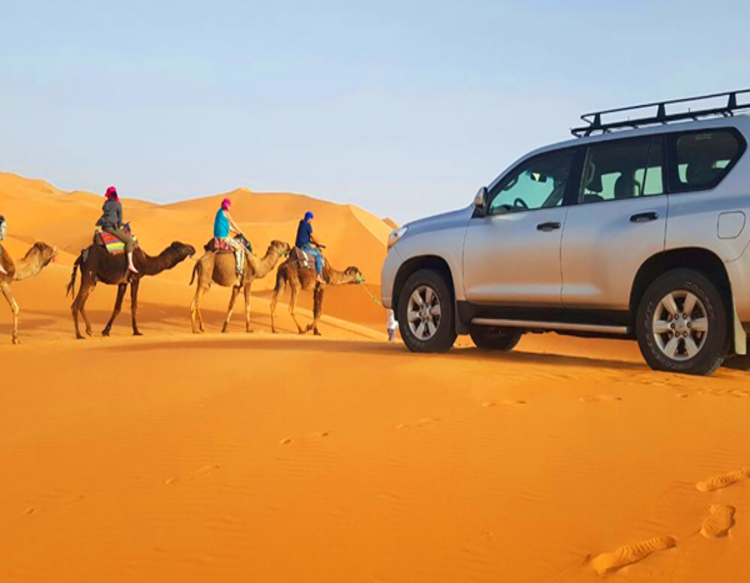
Time your arrival in the desert camp for late in the day. In the late afternoon, you may ride a camel or go across the neighboring dunes. Go on an adventure to the top of the Erg’s highest dune. Take in the breathtaking view of the setting sun from this vantage point before heading back to camp for a traditional Moroccan feast.
The plan is to spend tonight and tomorrow night in camp.
Desert of Erg Chigaga, Day 10
Day trip in the desert’s uncharted wildness with a picnic lunch under the shade of some trees.
Your driver will take you to a nearby nomad encampment so that you can have tea with a local family after a long day of sightseeing and exploring before heading back to camp for supper.
Sunset over the Erg Chigaga dunes; photo by Michael Breitung
Oasis of Tata on Day 11
Leave the desert to the north-west by way of the dry lake bed of Lake Iriqui, the Madouar canyon mountains, and the Acacia orchards. Off-roading during the first portion of the trip means more frequent opportunities to take pictures and look for fossils. Join the paved road again at Foum Zguid, where we’ll stop for lunch. Then, after passing through canyon reliefs and otherworldly geology, go west along the Jebel Bani range to reach Tata and its palm oasis.
You should stay at the Tata oasis both tonight and next night.
Oasis of Tata on Day 12
Take a trip to the desert oasis that lies just outside of Tata. The settlement of Agouliz, the Gorge, and the caverns, to name a few.
The Anti-Atlas Range
Taroudant, on Day 13
Today, as you make your way north to Taroudant, take in the sights of the Anti-Atlas range. Palm trees, canyons, and rocky mountains dot the landscape here. The ancient grain storage (agadir) of Tagmoute is a spectacular example of this style of earthern building and is located not far north of Tata (prevalent in the region).
Get down from the Anti-Atlas to the High Atlas’s lush Souss River basin. The citrus fruit and vegetables of Morocco are grown in the fertile soil of the vast river plain.
Taroudant is a walled, medieval village that you should reach by early afternoon. In comparison to Marrakesh, Taroudant’s medina is significantly smaller and less bustling with tourists.
Travelers could spend the day exploring the medina and taking pictures of the restored remparts of the city.
Spend the night on the outskirts of the medina.
It’s Day 14 and we’re in Marrakech.
You will be hitting the road again today, this time via the High Atlas Mountains, arriving in Marrakech in the late afternoon after a long day of traveling. Use the exciting Tizi n Test mountain pass throughout your travels (single track and winding in places, and with far-reaching views back down to the river plain below). You may see some of Morocco’s famous Argan trees as you climb up the mountain road, but beyond that, the slopes turn rocky.
The north side of the mountains is more green, with terraced fields and earthen dwellings dotting the mountainside.
Arrive to the 12th-century remains of the mosque of Tin Mal by early afternoon. The mosque has been partially repaired and is located in a remote area of the highlands (NB: the site was part of a large town, itself not evident, which was the seat of the Almohad dynasty, please refer to below section on Marrakech). The candidacy of the mosque to UNESCO has reached the final stages. To enter and look around at your own pace, a guard will let you in.
The mountains get more alpine as you near the valley of Ouirgane, and beyond that, at Asni, you can see Mt. Toubkal, the highest peak in North Africa.
Arrive in Marrakech’s old city, or medina, and settle into your riad for a two-night stay.
Marrakesh, Day 15
The old city of Marrakesh, known as the medina, has been designated as a World Heritage Site. Get your bearings by walking with a guide first thing in the morning.
Marrakech, often known as the “red city,” was historically a hub for commerce with sub-Saharan Africa, especially in the commodity trades of gold, slaves, leather, etc. In the medina, you will probably see at least one example of a ‘foundouk’ (or caravanserai), which served as housing for traveling merchants and their pack animals.
The city was founded in the 11th century, but the remparts (walls) we are familiar with today were erected in the 12th century (subsequently re-built).
The majestic Koutoubia Mosque and Minaret were built during the Almohads’ golden heyday of the 12th century (ref: Tin Mal above). Use the towering Koutoubia minaret as a landmark no matter where you are in the city.
Among the souks, we suggest the Maison de la Photographie, the Musee des Confluences (close to the Dar el Bacha), the Bahia Palace (19th century), and Le Jardin Secret. Your driver may take you to the gardens in the new town (Jardin Majorelle) early in the morning to avoid the lunchtime throng in the medina. Possibly comparable to the Jardin Majorelle is the botanical Anima Garden on the outskirts of town.
With Wild Morocco and the Medina of Marrakesh (credit Michael Breitung)
Day 16 :is departure day.
Airport transportation from Marrakech.
 English